School Smartphone Bans in California — The Full Debate
June 3, 2026 · 6 min read
California's school smartphone ban became law in 2024, making the state one of the first in the US to restrict phone use across all public schools. Governor Gavin Newsom signed the legislation after years of debate among parents, educators, and child health researchers. The law requires every California public school district to adopt a policy limiting or prohibiting smartphone use during the school day by July 2026. The goal is to improve student focus, reduce cyberbullying, and address the growing teen mental health crisis. But the debate is far from settled — and the evidence on both sides is more nuanced than either camp admits.
1. What California's School Smartphone Ban Actually Requires
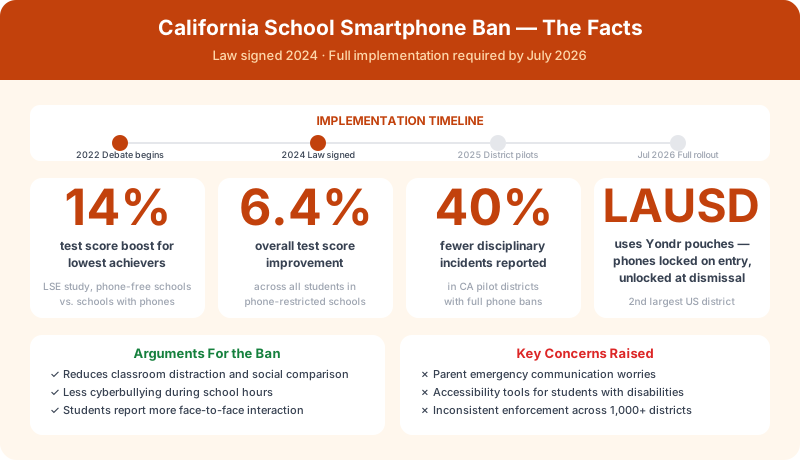
The law does not prescribe a single approach. It requires districts to create and enforce a policy — but leaves the specifics to local school boards. Some districts, including Los Angeles Unified, have moved toward full prohibition using Yondr pouches, which lock phones in soft cases that students carry but cannot open until they leave campus. Other districts allow phones in bags but not on desks. A few permit phone use at lunch. The result is a patchwork of policies across California's 1,000-plus school districts, which creates confusion for families who move between districts or have children at different schools. Consistency remains one of the biggest implementation challenges the state faces.
2. The Evidence Supporting Phone-Free Schools
The case for banning smartphones in schools is backed by a growing body of research. A landmark London School of Economics study found that restricting phone use in schools improved test scores by 6.4% overall — and by 14.2% for the lowest-achieving students. A 2023 study published in JAMA Pediatrics found a direct link between smartphone notifications and reduced working memory in teenagers. In California specifically, districts that piloted phone-free policies before the state law reported fewer disciplinary incidents, less cyberbullying reported to staff, and higher rates of students engaging in face-to-face social interaction during breaks. Teachers consistently report fewer interruptions and better classroom focus.
3. The Arguments Against the Smartphone Ban
Critics of the ban raise several legitimate concerns. Parents worry about emergency communication — the ability to reach their child quickly during a school shooting or other crisis. Civil liberties advocates argue that blanket bans are an overreach that does not account for the many legitimate uses of smartphones, including accessibility tools for students with disabilities and translation apps for English learners. Some educators argue that teaching responsible technology use is more valuable than prohibition — that banning phones creates a generation that has never learned self-regulation. There is also a socioeconomic dimension: Yondr pouches cost districts money that under-resourced schools may not have.
- Parent communication concerns during emergencies
- Accessibility tools for students with disabilities depend on phones
- Translation apps support English language learners in real time
- Critics argue prohibition prevents teens from learning self-regulation
- Implementation costs are highest for already under-resourced schools
- Enforcement relies on teacher time that could go to instruction
4. How the Ban Affects Student Learning and Academic Performance
The academic case for phone-free schools is strong, particularly for students who are already struggling. Research consistently shows that the mere presence of a smartphone on a desk — even face-down and silenced — reduces available cognitive capacity because the brain uses resources to resist the temptation to check it. For students preparing for AP exams, the SAT, or ACT, the ability to sustain deep focus for extended periods is a core skill. Schools that have fully removed phones from classrooms report that students are re-learning how to tolerate boredom — which sounds trivial but is actually a foundational skill for academic work and for concentration during high-stakes tests.
Help your student build academic focus:
5. The Mental Health Dimension
One of the strongest arguments for the smartphone ban comes from adolescent mental health research. Social media use during the school day — checking likes, reading comments, comparing social status — activates the same stress-response pathways that make academic anxiety worse. For teenagers whose self-esteem is already fragile, the classroom should be a space where social comparison is muted. Phone-free policies remove one significant source of real-time social pressure. Early reports from California districts with full bans suggest students are talking to each other more during breaks. For many teenagers, particularly those who are shy or socially anxious, face-to-face conversation practice during the school day is genuinely valuable.
6. What Parents Can Do Right Now
Regardless of which policy your child's district has adopted, parents can take practical steps at home that reinforce the benefits of phone-free focus time. Establish phone-free homework hours — ideally with the phone in a different room, not just face-down on the desk. Research shows that having the phone out of sight, not just silenced, is the threshold that restores cognitive capacity. Discuss the ban with your teenager openly rather than treating it as a punishment. Help them understand what the research says about attention and performance. If your student is using phone time that should be study time, they may need structured academic support to catch up.
Support your student's academic performance:
7. The Bigger Picture — Technology, Attention, and Learning
California's smartphone ban is not just a school policy debate. It is part of a broader societal reckoning with what constant connectivity is doing to developing minds. The teenagers in California's classrooms today are the first generation to have grown up entirely within the smartphone era. The long-term effects of that exposure are still being measured. What is already clear is that sustained attention — the ability to stay with a difficult problem long enough to solve it — is becoming rarer and more valuable. Whether the ban achieves its goals will depend on consistent enforcement, parental reinforcement at home, and a school culture that makes phone-free time feel normal rather than punitive.
The smartphone ban in California schools is a bold experiment. The research broadly supports the direction. But a policy alone cannot close the attention and learning gaps that have built up in students over years. Families who combine supportive home routines with targeted academic help — including one-on-one tutoring where needed — will see the best results. The phone can wait. The learning cannot.