College Admissions Stress in California: Is It Worth It?
June 3, 2026 · 7 min read
College admissions stress in California has reached levels that many child psychologists describe as a public health issue. Across the state's most competitive high schools — from Palo Alto to Irvine — teenagers are building schedules that leave almost no room to be young. Five AP classes, varsity sport, student government, volunteering, SAT prep, and a side project that demonstrates entrepreneurial spirit. All before the age of eighteen. The promise behind this pressure is access to a prestigious university. But a growing body of research asks a harder question: what is the cost of that race, and is the destination actually worth it?
1. How College Admissions Pressure Became a Crisis in California
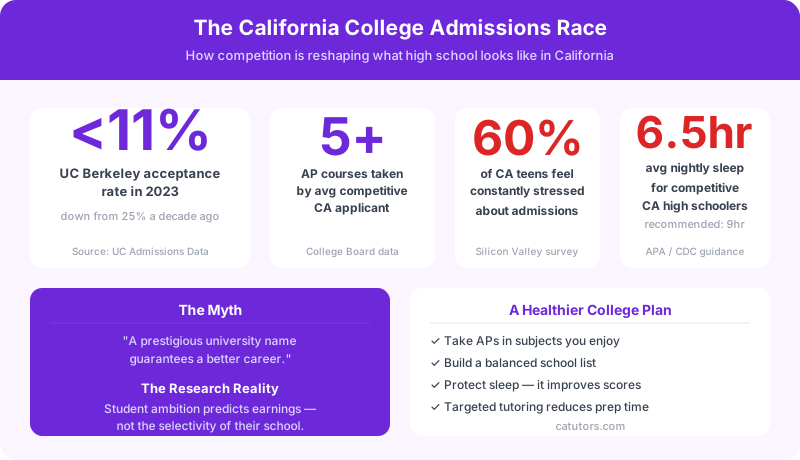
California is home to some of the most sought-after public universities in the world. UCLA, UC Berkeley, and UC San Diego consistently rank among the top universities globally. Acceptance rates at these schools have dropped sharply over the past decade — UC Berkeley's acceptance rate fell below 11% in 2023. As competition intensified, the arms race began. High schools in wealthy districts started offering more AP courses. Parents began hiring college counselors for students as young as 13. The bar for what counts as a competitive application kept rising — and the teenagers caught in the middle bore the weight of expectations that most adults would find unmanageable.
2. The Real Toll on California High Schoolers' Wellbeing
The American Psychological Association consistently identifies school and future uncertainty as the top stressors for American teenagers. In California's high-achieving districts, those stressors are amplified. A 2022 survey of students in Silicon Valley schools found that 60% reported feeling constantly stressed, and more than a third said they frequently felt hopeless. Burnout — once a term reserved for overworked adults — is now routinely diagnosed in 16-year-olds. Sleep deprivation is endemic. Many students report finishing homework past midnight, then waking before 7am for zero-period classes. The biological damage of chronic sleep loss in adolescence is well-documented and serious.
3. When Achievement Becomes a Trap
The cruelest aspect of California's college admissions culture is that it rewards students for hiding struggle. Admissions essays demand narratives of resilience and growth — but the unspoken rule is that the growth must look effortless. Students learn early that showing stress, asking for help, or choosing sleep over homework signals weakness. By the time they arrive at university — often exhausted and hollowed out — many have no idea how to function without an external achievement structure telling them what to do next. The campus mental health crisis at California's top universities is a direct downstream consequence of this pressure system.
Help your teen prepare smarter, not harder:
4. The Myth of the Name-Brand University
Research repeatedly shows that the prestige of an undergraduate institution matters far less than students and parents believe — particularly for outcomes later in life. A landmark study by economists Stacy Dale and Alan Krueger found that students who were admitted to elite universities but chose to attend less selective schools earned just as much over their careers as those who went to the elite institution. What predicted long-term success was the student's own ambition and engagement, not the name on the degree. For most career paths, a motivated student at Cal State Long Beach will outperform an uninspired one at UCLA. California's public university system, at every tier, is an excellent education.
5. What a Healthier Approach to College Planning Looks Like
The antidote to college admissions stress is not lowering ambition — it is recalibrating what ambition means. Encourage your teenager to pursue subjects they genuinely find interesting rather than stacking AP courses to impress an admissions reader. Depth in two or three areas is more compelling than a thin spread across eight. Build a balanced college list that includes reach schools, realistic matches, and strong safety options where your student would genuinely thrive. Remind them — often — that where they go to university is the beginning of the story, not the whole story. Their effort, curiosity, and resilience matter far more than any acceptance letter.
- Choose AP courses in subjects your teen actually enjoys, not just for prestige
- Build a balanced list: 3 reach, 4 match, 3 strong safety schools
- Prioritise sleep — chronically sleep-deprived students perform worse on the very tests they are sacrificing sleep to prepare for
- Separate your teen's worth from their GPA in every conversation you have
- Explore CSU and UC campuses beyond Berkeley and UCLA — many are exceptional fits
- Consider a gap year if burnout is severe — universities respect intentional breaks
6. The Role of Targeted Academic Support
One practical way to reduce college admissions stress is to close specific academic gaps early and efficiently, rather than letting anxiety about grades build for months. A private tutor who works one-on-one with your student can identify exactly where the gaps are and address them directly — often in far fewer sessions than parents expect. This targeted approach means students spend less total time on academic catch-up, freeing space for sleep, physical activity, and the kind of unstructured time that is essential for adolescent mental health. Tutoring is not a last resort. Used well, it is a tool that makes the rest of the schedule more manageable.
Find targeted academic support:
7. Talking to Your Teen About College Without Adding to the Pressure
The language parents use around college matters more than most realise. Phrases like "you need to get into a good school" or "what will people think if you don't get in" add to the pressure without adding any useful information. Instead, ask your teenager what they want their daily life to look like at university — the size of the campus, the type of city, what they want to study. Make the conversation about fit, not prestige. When your student sees you genuinely curious about what would make them happy — rather than what would make you proud — the entire dynamic around college planning shifts for the better.
California's college admissions culture will not change overnight. But individual families can choose to opt out of the worst of it. Your teenager's wellbeing is not a trade-off for a better application — it is the foundation that makes everything else possible. Invest in their health, their curiosity, and their confidence now. The rest follows.